Coming to iOS and Android on 1 October.

Stop finding out eight months too late.

Every app is built to get you a date. Jingles is built for the part they all call someone else’s problem: what happens once you are already talking.

Where are you right now? Optional

Beta test invites start going out on 1 October, oldest signups first. One email when it is your turn. Nothing else, and never your address to anyone.

Launching on
iOS + Android
Mediators to choose from
Nine
The window it is built for
48 hours

What you see

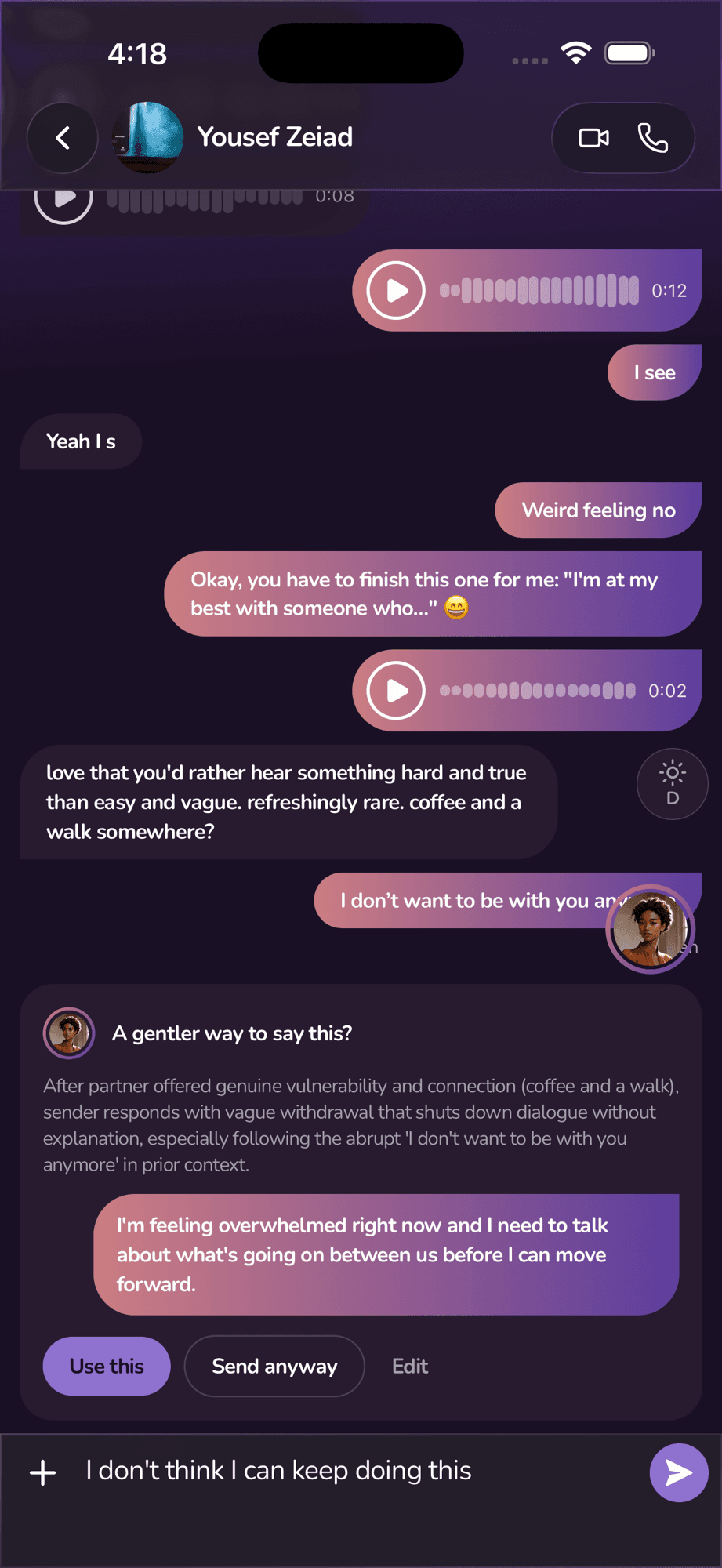
The sender's screen: a draft message, and a coaching panel asking whether there is a gentler way to say it, with the reason it noticed and a suggested rewrite.

What they see

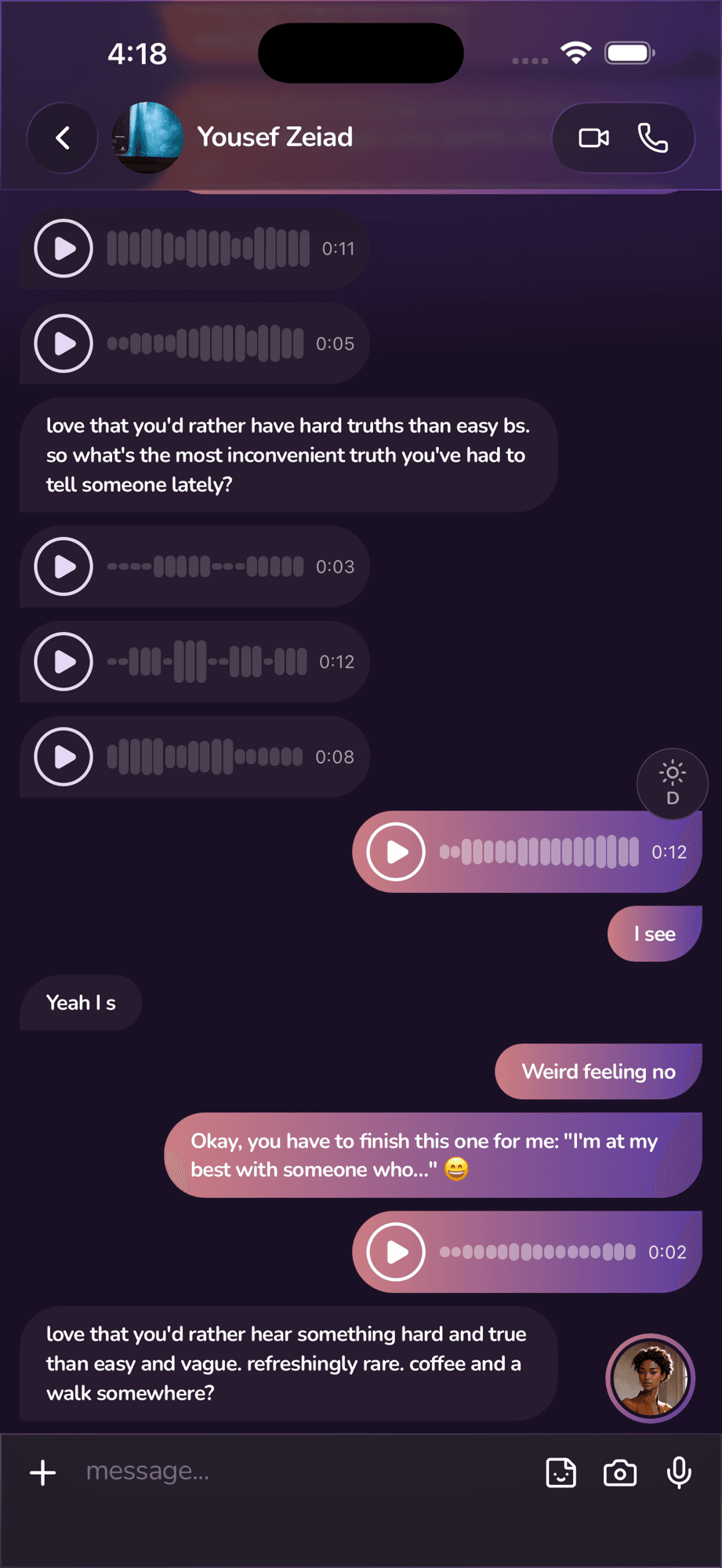
The same conversation on the other person's phone at the same moment: no panel, no draft, no indication that anything was suggested.

Real screens from the app · both sides of one conversation, at the same moment

Whether you are looking, or already found them.

Jingles works differently depending on where you are. You pick when you join, and you can change it later.

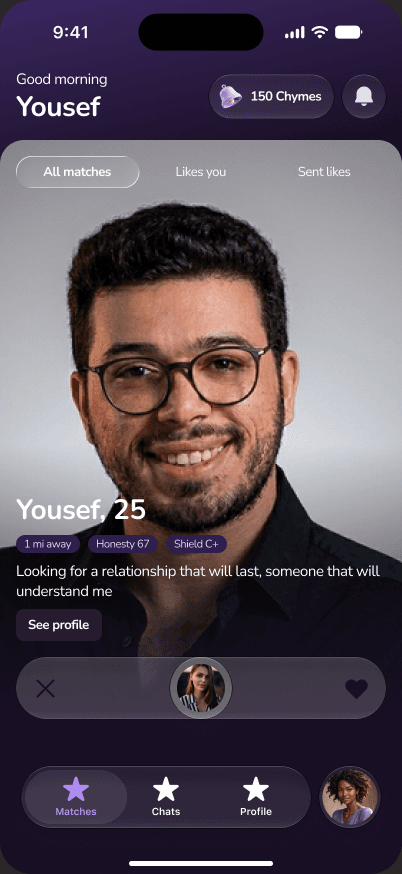
The Jingles match deck, showing a profile with distance, honesty and shield badges.

If you are single

You do not need more matches. You need to know which one is worth a year.

Every other app optimises for the match. Jingles optimises for the eight months after it, so you find out early, not late.

  • Before you match: four axes on how the two of you would actually work, drawn from real instruments rather than a personality quiz
  • A coach that is only yours, that knows your history and helps you read what is happening from the first message
  • The thing that catches the message you would have regretted sending at 1am
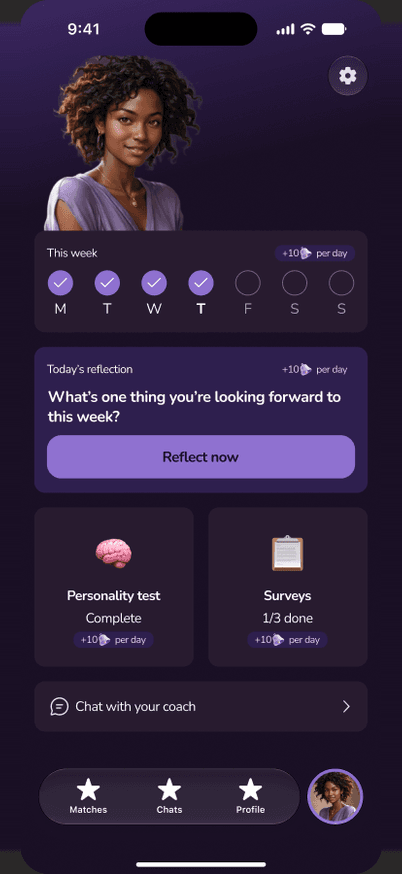
The Jingles coach dashboard, showing the week's reflection streak and today's prompt.

If you are already together

The part every other app calls someone else’s problem.

Nothing exists for the middle of a relationship. Jingles is built for the ordinary Tuesday and the bad Thursday.

  • One mediator the two of you choose together, in the chat and inside the call
  • A private coach each, which can never read one another
  • A structured way back in the 48 hours after a fight, which is the window that decides whether couples recover

Nothing is in the room at 11pm on a Tuesday.

You are both there. Neither of you is talking. Nothing dramatic happened. It is just the third night like this, and now the silence is the thing you are having an argument about.

Dating apps got you in the door and then had nothing more to say. Worksheets are homework neither of you will do. A therapist is three weeks out and two hundred dollars an hour.

The moment you need something is precisely the moment nothing exists. That is the whole gap, and it is what Jingles is for.

How it works

01

You both pick one mediator

Nine of them, each with a different temperament. You choose together, and that choice is shared. It is not assigned to you, and it is not a different AI for each of you.

02

You each get a coach that is only yours

A private thread nobody else can reach. It knows your side, your history and what you actually meant. Your partner has their own, and the two never meet.

03

It shows up at the moments that decide things

Before you send the message you would have regretted. In the call, if something is going wrong. And in the 48 hours after a fight, which is the window that actually decides whether a couple recovers.

Why this and not something else

The couples who last are not the ones who fight less.

Four decades of couples research keeps arriving at the same unglamorous finding. What predicts whether two people stay together is not how often they argue, how much money they have, or how alike they are. It is whether a repair attempt gets made after the argument, and whether the other person takes it.

Every couple fights. The ones who last repair well. That window is roughly 48 hours wide, it decides more than anything else in the relationship, and no product has ever been built for it.

What it does when it actually matters.

In the call

A third voice, in the room, that mostly stays quiet.

Invite the mediator into a voice or video call and it speaks out loud, over the same audio as your partner. Not a transcript afterwards. Not a notification. It is in the conversation while the conversation is happening.

  • Five interventions per call, total, then it stops
  • It only speaks when something actually happened. The fixed-interval tips were deleted
  • Both of you hear the same thing at the same time
9:41
Live · 12:04Maya is speaking
You
Sam

“You both said the same thing thirty seconds apart. Sam, can you say it again, and this time say what it cost you?”

9:41

Repair window

You have 30 hours left.

0h

The fight

6h

Both of you get a private prep

18h

A 25-minute session, facilitated

48h

After this the window closes

Start the sessionEither of you can decline

After a fight

The 48 hours that decide whether you recover.

When things go badly, Jingles opens a repair window. You each get a private prep with your own coach, then a short facilitated session together. Either of you can decline, at any point, and the other is never told you refused.

  • Symmetric by construction: same flow, same prep, for both of you
  • A successful session does not require agreement, and the mediator is forbidden from pushing for one
  • Twenty-five minutes, not an evening
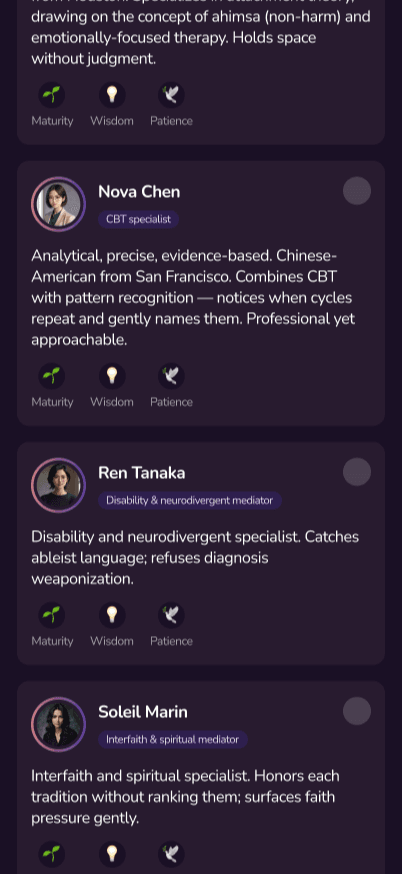
The Jingles coach picker, listing mediators with their specialisms and temperaments.

Nine to choose from

You pick who is in the room with you.

Not one assistant with a personality setting. Nine distinct mediators, each with their own training and their own way of handling a hard moment, and the two of you choose together.

  • Specialisms, not flavours: a CBT specialist, a disability and neurodivergent mediator, an interfaith mediator, and six more
  • Recommended from how you actually answered onboarding, never assigned
  • Change your mind whenever you like. It is a choice, not a lock-in

Before you match

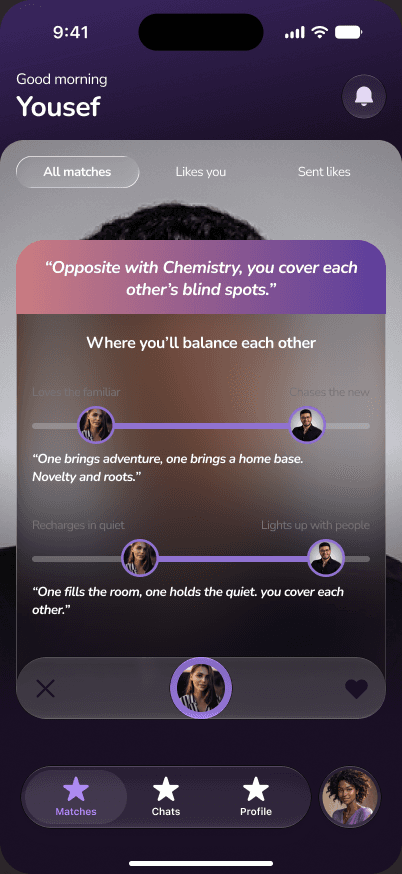
Not a score. Where the two of you would balance each other.

Each reading places you both on a spectrum between two real tendencies: loves the familiar against chases the new, recharges in quiet against lights up with people. Then it says in plain words what that would actually be like.

  • Built from nine assessment instruments, not a personality quiz
  • A tendency with nothing useful to say about this pairing does not get a row
  • Star signs are a filter you can use. They never touch the reading
The Jingles insight panel, showing two people placed on spectrums between opposing tendencies, each with a written reading.

The part most of the work went into

What it is not allowed to do.

An AI sitting inside a relationship can do a great deal of damage by being helpful. Most of the last four months went into the refusals rather than the features.

  • It never repeats what you told your coach to your partner.
  • It notices when a voice doesn't match the words, and never shows that to anyone but you.
  • It doesn't call anyone a narcissist, a liar, or avoidant. Behaviours, never labels.
  • In a call it gets five interventions, total. Most calls it stays quiet.

The questions people actually ask.

Mostly about who can see what. Those are the right questions to ask an app like this one.

Will my partner see what I tell my coach?

No. Your coach and the shared mediator are separate stores with separate access rules. This is the database schema, not a policy we promise to follow. If the thing you vent to could quote you back to your partner, it would not be a coach. It would be a witness.

Can it tell me whether my partner is lying?

It will never tell you that. Jingles reads consistency in your own behaviour and shows it only to you, about you. Pointing that at another person would turn a relationship app into a weapon, and hand it to whoever was already the problem. So it does not exist, and it is not on the roadmap.

Is this therapy?

No, and we will not call it that. Jingles is a communication and coaching tool. It does not diagnose, it does not treat, and it is not a substitute for a licensed professional. When a conversation needs one, it says so rather than trying to handle it.

Does my partner need it too?

For the shared mediator and for repair sessions, yes, both of you. The private coach works on its own, so you can start before they are ready.

What does it cost?

Not decided yet, and we would rather say that than invent a number. Everyone on this list hears it before anyone else, and the first wave of invites gets a longer free run.

What happens to what I write?

It stays in your account. It is never sold, never used to train a public model, and never shown to your partner. Delete your account and it is gone. Not archived, not anonymised. Gone.

1 October · iOS and Android

Stop finding out too late.

It is not in the stores yet. Leave an address and you will be in the first wave of invites, and you will hear the price before anyone else does.

Where are you right now? Optional